
Featured Client

The Challenge
From September 1 to October 15, 2025, several clients experienced a complete Google Ads shutdown, spending $0 on PPC. This pause provided a unique opportunity to evaluate how a strong organic foundation could sustain performance when paid search traffic stopped entirely.

Solution
They focused on strengthening the dealership’s organic foundation to maintain visibility and sales during the PPC pause. Their goal was to reduce wasted ad spend by ensuring paid and organic efforts worked together—capturing more qualified traffic without paying for clicks the brand could earn naturally.
Many brands instinctively respond to performance dips by increasing Google ad spend—investing additional budget to recapture results that a strong organic foundation could have sustained. In doing so, they often pay for clicks they would have earned organically, inadvertently cannibalizing their own performance.
This case study shows what happens when paid media goes dark—and Organic takes the lead.
A high-volume automotive client hired Stream Companies to manage its full-funnel marketing strategy, including paid search, SEO, and social media. The dealership consistently sells a large volume of vehicles per month and typically invests $28,000 per month in Google Ads.
Approach
Stream Companies had already built a robust SEO strategy for the client, focusing on:
- Optimized local landing pages for each key service and inventory category.
- Strategic on-site content and schema markup to capture branded and non-branded searches.
- Enhanced Google Business Profile engagement to drive local discovery.
- A long-term link-building and technical optimization plan to reinforce domain authority.
This setup allowed Stream to isolate and compare performance between:
- Pre-shutdown period: August 1–15
- Shutdown period: September 1 – October 15
Results
- Traffic Performance (GA4 Data)
When paid search spend dropped to $0, overall site engagement didn’t just hold—it grew. Total sessions increased by 5.09%, and engaged sessions rose by 5.88% compared to the pre-shutdown period, despite the complete pause in Google Ads.
- Direct sessions increased by 66.73%, showing how established brand equity and returning users filled the gap left by paid search.
- Organic sessions climbed by 34.04%, supported by Stream’s long-term SEO strategy and consistent on-page optimization.
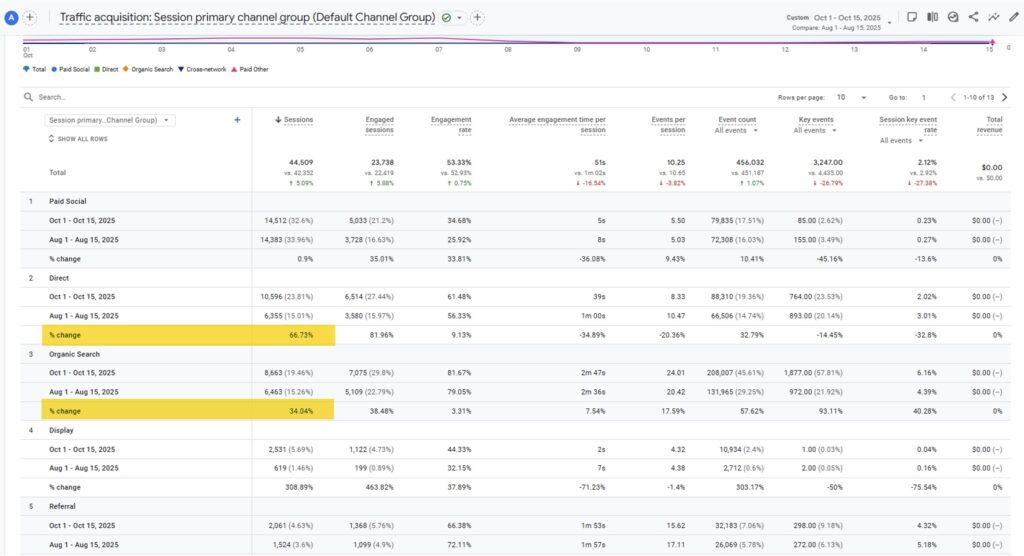
Together, these two channels sustained total traffic and engagement while paid campaigns were dark, demonstrating that strong brand visibility and search authority can stabilize performance, even in the absence of paid media.
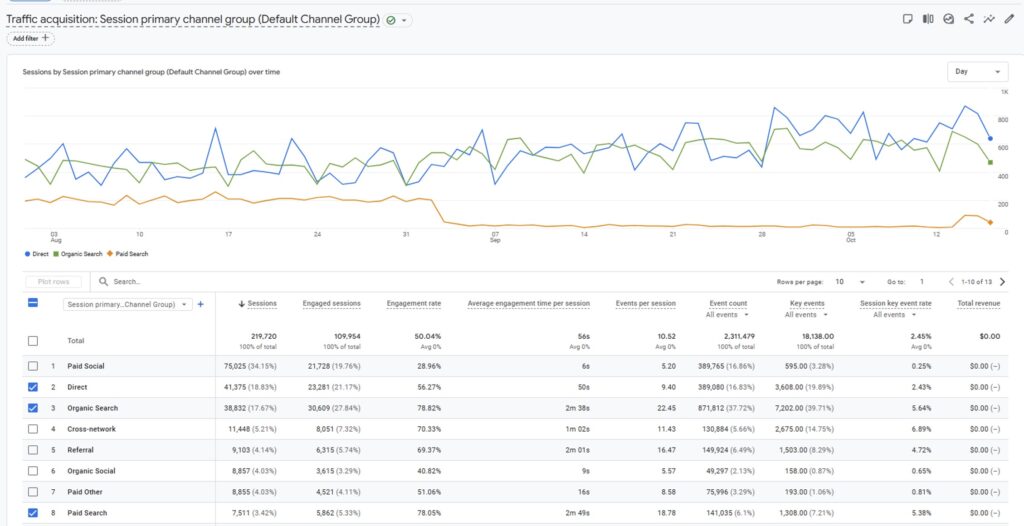
With paid search paused, Organic and Direct channels filled the gap—proving the resilience of Stream’s organic strategy.
- Lead & Sales Impact
Despite the pause in paid advertising, the dealership maintained a steady sales performance, supported by high-quality organic and direct leads.
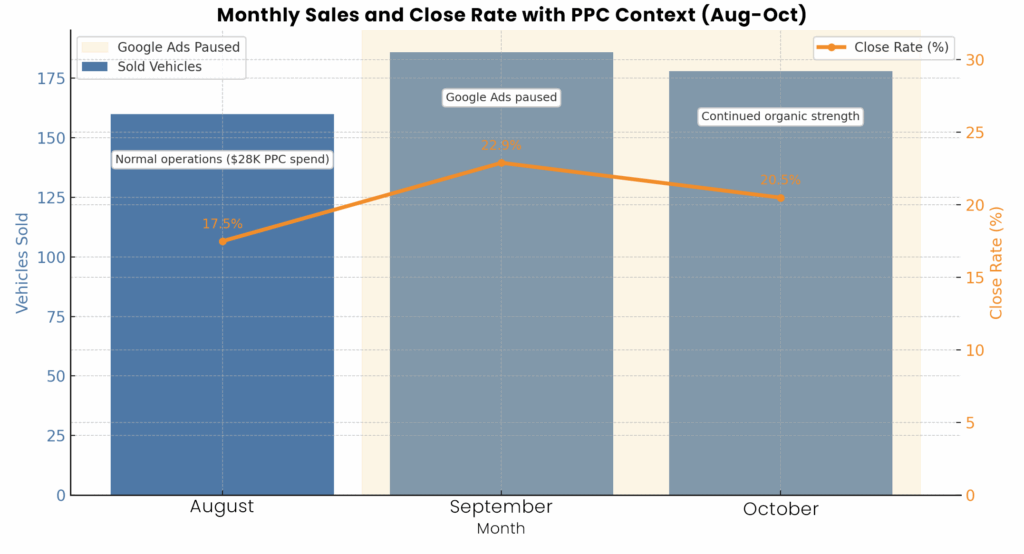
Even without paid media, the dealership sold more vehicles in September and October than in August, highlighting the stability of an established organic funnel.
Key Takeaway
Paid and organic channels work best as a unified system—one drives demand, the other sustains it. Stream’s SEO strategy allowed the dealership to maintain sales and visibility during a PPC pause, reinforcing that a strong organic presence isn’t a substitute for paid search, but serves as the safety net that keeps performance steady when paid activity changes.
This case also highlights a larger industry truth: marketers have become conditioned to “pull the trigger” on increased Google ad spend at the first sign of slowing performance. In many cases, those dollars simply cannibalize organic traffic—paying for clicks the brand could have earned organically.
A robust organic strategy is not just an efficiency measure; it’s a critical component of long-term marketing stability. When organic and paid efforts are aligned instead of competing, brands can invest smarter, spend less wastefully, and build a foundation that sustains results regardless of shifts in media budgets.
Build a Foundation That Sustains Performance—Even When Paid Media Stops
When this high-volume auto dealer paused its $28K Google Ads budget, traffic and engagement didn’t drop. Thanks to Stream Companies’ long-term SEO strategy, organic sessions rose 34%, direct sessions jumped 67%, and sales remained strong. A resilient organic funnel kept the business growing without paid support.
Let’s Strengthen Your Organic Strategy to Maximize Every Marketing Dollar
Connect With Us Today